

Prof. Lingyun Xiang's New Book "Trusted Data Assets" Published by Guangming Daily Press
Decoding the Underlying Logic of Wealth in the Next Decade
Beijing, July 16, 2026 (GLOBE NEWSWIRE) -- Against a backdrop of frequent data breaches and eroding algorithmic trust, a new work that seeks to rebuild the foundations of trust in the data economy — Trusted Data Assets: Reconstructing Human Trust Through AI and Blockchain — has been published by Guangming Daily Press. Authored by economist and multi-national academician Prof. Lingyun Xiang, the roughly 200,000-character volume examines, across technology, finance, law and investment, one increasingly pressing question: as data comes to be regarded as a new factor of production and a new asset class, on what basis can it be trusted?
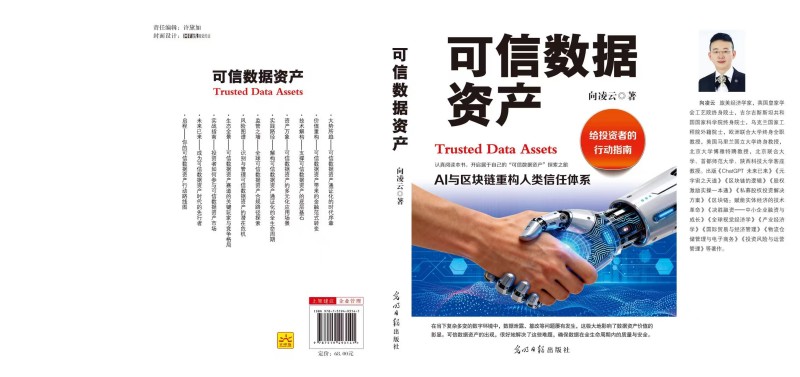
Trusted Data Assets — a work built around "AI and Blockchain: Reconstructing Human Trust"
Addressing a Defining Question of the Digital Economy
The book is built around a central tension in today's digital economy: although the notion that "data is a new factor of production" has become widely accepted, the pathways that would allow data to be held, priced, traded and financed in the manner of conventional assets remain unclear. Because data is easily copied, prone to tampering and difficult to attribute in terms of ownership, it has long remained at the level of a "resource" rather than a true "asset" in the strict sense.
Xiang argues in the book that this impasse is now being broken by two converging technologies: blockchain answers the question of whether data can be trusted, while artificial intelligence answers the question of how much value data can generate. It is at the intersection of these two forces that he locates what he calls the "trusted data asset." In the book's preface, he writes:
"The tokenization of trusted data assets is not a fleeting technological fad. It is a broad trend driven by the confluence of technology, economics and market demand. To understand trusted data assets is to understand the underlying logic of wealth creation and distribution in the next decade."
Leading industry research houses forecast that the on-chain real-world asset (RWA) market could exceed US$16 trillion over the coming decade. Against this backdrop, the central question the book seeks to answer is how to build a workable and credible institutional framework spanning technology, finance, law and regulation.
Structure, Content and Editorial Approach
Trusted Data Assets (TDA) runs to approximately 200,000 characters across ten chapters, following an internal logic that moves from context to technology, then to practice, risk and outlook — building a comprehensive knowledge system that progresses from the accessible to the advanced.
The book opens with the macro context, tracing the evolution of the traditional financial system and the internal drivers of its shift on-chain. It sets out how trusted data assets can deliver gains in efficiency, unlock liquidity, lower barriers to participation and enhance transparency. On the technical side, the author unpacks the foundational building blocks one by one — distributed ledgers, smart contracts, stablecoins, oracles and zero-knowledge proofs — writing under the guiding principle that "a technologist should be able to follow the finance, and a finance professional should be able to follow the technology," so as to lower the cross-disciplinary barrier to entry.
Building on this contextual and technical foundation, the book devotes substantial space to its "practice" section. From bonds and private credit to real estate, commodities and intellectual property, the author walks through the tokenization pathways of different asset classes, tracing the full life cycle from asset selection, legal structuring (including SPV design), due diligence and issuance through to clearing and settlement. On the widely debated topics of compliance and regulation, a dedicated chapter surveys the frameworks and evolving approaches to digital-asset compliance across major jurisdictions worldwide, helping readers understand the underlying logic behind different market regimes.
The second half of the book turns to risk and outlook. Xiang provides a systematic account of key risks — including technical vulnerabilities, market volatility, private-key loss and counterparty failure — along with corresponding mitigation strategies. In a chapter on the broader ecosystem, he maps the multi-sided competition and cooperation between traditional financial institutions and leading DeFi players. Transitioning through practical guidance tailored to different investor profiles, the closing chapter offers an outlook on "the tokenization of everything," the convergence with digital currencies and future collaboration with AI systems.
Stylistically, the book balances academic rigor with operational practicality. It draws on a wide range of industry cases and data while avoiding the conceptual clutter that often afflicts specialist technical texts. According to the publisher, the author spent roughly two years on the book, conducting field research at financial institutions, technology companies and regulatory research bodies, with the aim of ensuring that "every technical judgment is backed by a real industry footnote."
Core Thesis: From Institutional Trust to Algorithmic Trust
If the book has a single unifying thesis, it is what the author describes as a "migration of trust paradigms." For centuries, human society has relied on institution-based trust — banks, governments, law firms, rating agencies — to underwrite economic activity. Blockchain, Xiang argues, is quietly enabling a historic shift toward algorithm-based trust.
The author is careful to note that this is not about replacing institutions, but about assigning institutions and algorithms to their most appropriate roles. He defines tokenization as "a fundamental reconstruction of the form of ownership itself," rather than a mere digital overlay. An office building can be divided into tens of thousands of tradable interests; a stream of royalty income can be fractionalized and invested in globally. What is released in the process, he argues, is a long-locked liquidity premium. The broader social significance, he sums up in a single phrase: "the democratization of ownership."

Prof. Lingyun Xiang, author of Trusted Data Assets
About the Author
Prof. Lingyun Xiang is a US-based economist and a leading scholar in artificial intelligence and financial innovation for emerging industries. He is a Fellow for Life of the Royal Society for the encouragement of Arts, Manufactures and Commerce (RSA) in the United Kingdom, an academician of several national academies of science and engineering, and holds tenured and visiting professorships at a number of leading international universities. In China, he serves as a visiting professor at Beijing Union University, Capital Normal University, Shaanxi University of Science and Technology, and Southwest Petroleum University, among other institutions.
His research spans macroeconomics, the digital economy and intelligent manufacturing. He is the author of numerous books, including Intelligent Manufacturing, ChatGPT: The Future Has Arrived, The Metaverse: The Way of a New World, The Logic of Blockchain, Blockchain: A Technological Revolution Empowering the Real Economy, A Practical Guide to Equity Incentives, Private Equity Investment Solutions, Winning at Financing: SME Growth and Capital Strategy, Global Visual Economics, Industrial Economics, International Trade and Economic Management, Logistics, Warehousing and E-Commerce and Investment Risk and Operations Management. Trusted Data Assets (TDA) is his most recent work at the intersection of the digital economy and emerging finance, and represents his most systematic treatment to date of trusted data assets and tokenization.
Intended Audience and Reader Value
The tagline on the book's cover — "An Action Guide for Investors" — offers a clear indication of the audience the author has in mind. The book is written for three broad groups of readers, each of whom will find a distinct layer of value.
For professionals in financial institutions, it offers a comprehensive map of the TDA landscape — from underlying technology and asset classes to compliance pathways — and can serve as a desk reference for business development and product design. For corporate executives, it provides a strategic framework for positioning data-elements strategy and for evaluating the inputs and outputs of digital transformation. For general investors, it offers a practical reference for identifying genuine opportunities and steering clear of pitfalls in an early-stage tokenization market marked equally by opportunity and noise.
In discussing the book's publication, a representative of Guangming Daily Press noted that Trusted Data Assets combines depth of thought, technical precision and operational relevance, standing out among domestic titles on the subject as a rigorous and forward-looking work — one expected to attract broad interest among readers in finance, technology, academia and investment.
Distribution and Upcoming Events
Trusted Data Assets (TDA) is now officially available from Guangming Daily Press, with copies being distributed through all major book retail channels nationwide. In the months ahead, Prof. Xiang is expected to participate in a series of academic symposia, university lectures and reader dialogues, engaging with scholars, industry professionals and general readers on topics ranging from trusted data assets to the convergence of AI and blockchain.
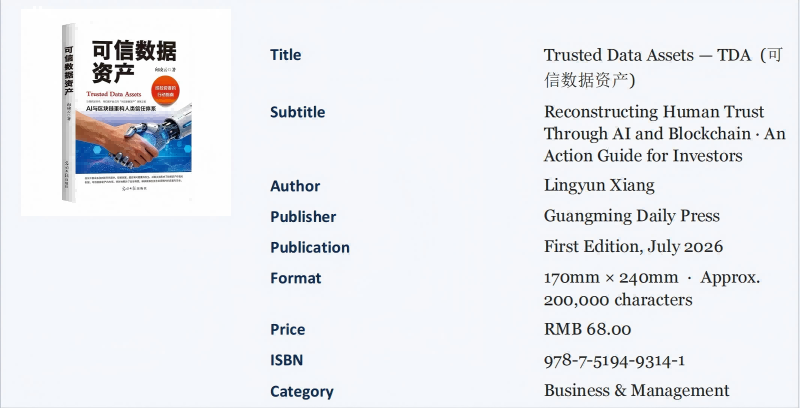
BOOK INFORMATION

Guangming Daily Press
Address: No. 106 Yong’an Road, Xicheng District, Beijing 100050, China
Postal Code: 100050
Website: https://book.gmw.cn/node_64269.htm
Email: gmrbcbs@gmw.cn
Contact Person: Ms. Xu Dairu
Legal Disclaimer:
EIN Presswire provides this news content "as is" without warranty of any kind. We do not accept any responsibility or liability for the accuracy, content, images, videos, licenses, completeness, legality, or reliability of the information contained in this article. If you have any complaints or copyright issues related to this article, kindly contact the author above.
